creating Wake Zone (Manatee skull)
A new beginning; the start of yet another exploration of repurposing discarded textiles into art that is edgy, delicate, and meaningful.
Wake Zone came about as a direct result of my Soul Tides exhibition at the Tampa Bay Watch Discovery Center.
When I first met with the Discovery Center coordinators to discuss a potential solo exhibition, I did a site visit to understand the space. Unlike a traditional gallery, the Discovery Center is a hybrid educational environment filled with aquariums, touch tanks, live marine life, microscopes, and interactive exhibits. Among these displays were two simple pedestals holding a manatee skull and a bottlenose dolphin skull. They immediately caught my attention.
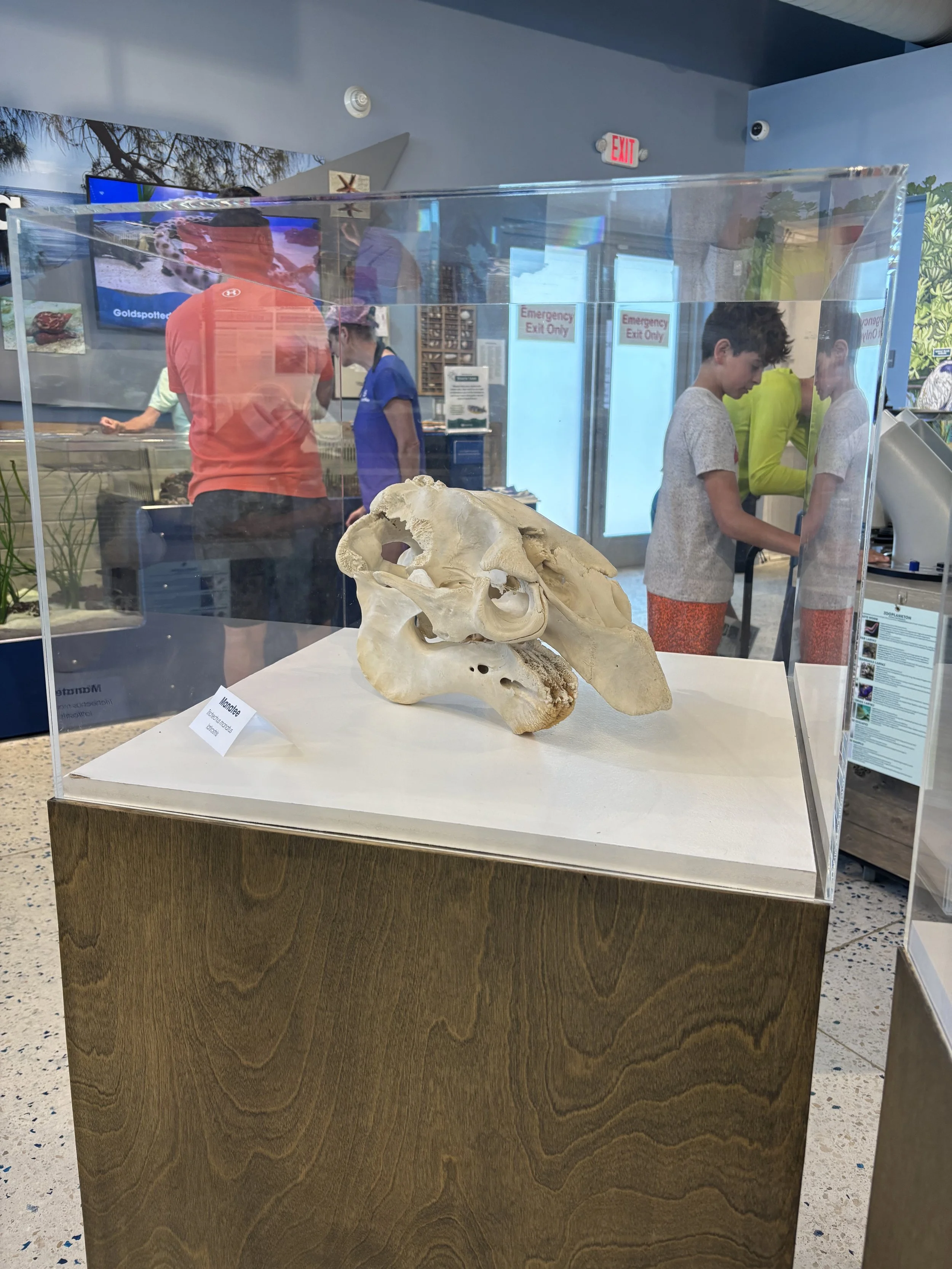
Manatee skull on display during my first site visit at the Tampa Bay Watch Discovery Center.
During my time at New College of Florida, I concentrated on conceptual sculpture, and since then I’ve been developing a series of sculptural works using recycled textiles. Most of these forms are soft and plush, but I’ve been increasingly interested in pushing beyond those limitations. How could I create recycled textile sculptures that retained more complex, structural forms? How could I combine softness with permanence?
At first, I dismissed the idea of making plush skulls. It didn’t feel true to the level of craftsmanship or visual language I wanted to achieve.
Then I thought back to another chapter of my practice. After graduating, I worked as a sculptural fabricator on large-scale public artworks, where I spent my days bending, shaping, and constructing metal. Metal has an incredible ability to hold form, and I became fascinated by what might happen if I paired that rigid structure with delicate recycled textiles.
The vision arrived almost instantly: recreate the manatee and dolphin skulls using wire wrapped in translucent recycled fabric.
What excited me wasn’t just the imagery—it was the conversation between the materials. The combination of metal and textile felt like a natural meeting point between two very different parts of my artistic background. It was one of those rare moments where an idea feels both unexpected and inevitable.
Of course, the concept was the easy part.
The real challenge was figuring out how to build it.
I had never made anything like this before. I needed to determine what gauge wire would be strong enough to support itself while remaining flexible enough to create the intricate curves of the skulls. I spent weeks experimenting with different materials, testing their strength, and learning how each behaved.
As I researched possible approaches, I revisited the work of Do Ho Suh, whose monumental fabric installations have long fascinated me. His ability to transform soft textiles into architectural forms became an important source of inspiration. I also spent time studying the sculptures of Jannick Deslauriers, whose intricate textile constructions demonstrate an extraordinary level of craftsmanship. While neither artist revealed a step-by-step process, studying their work encouraged me to keep experimenting until I found my own.
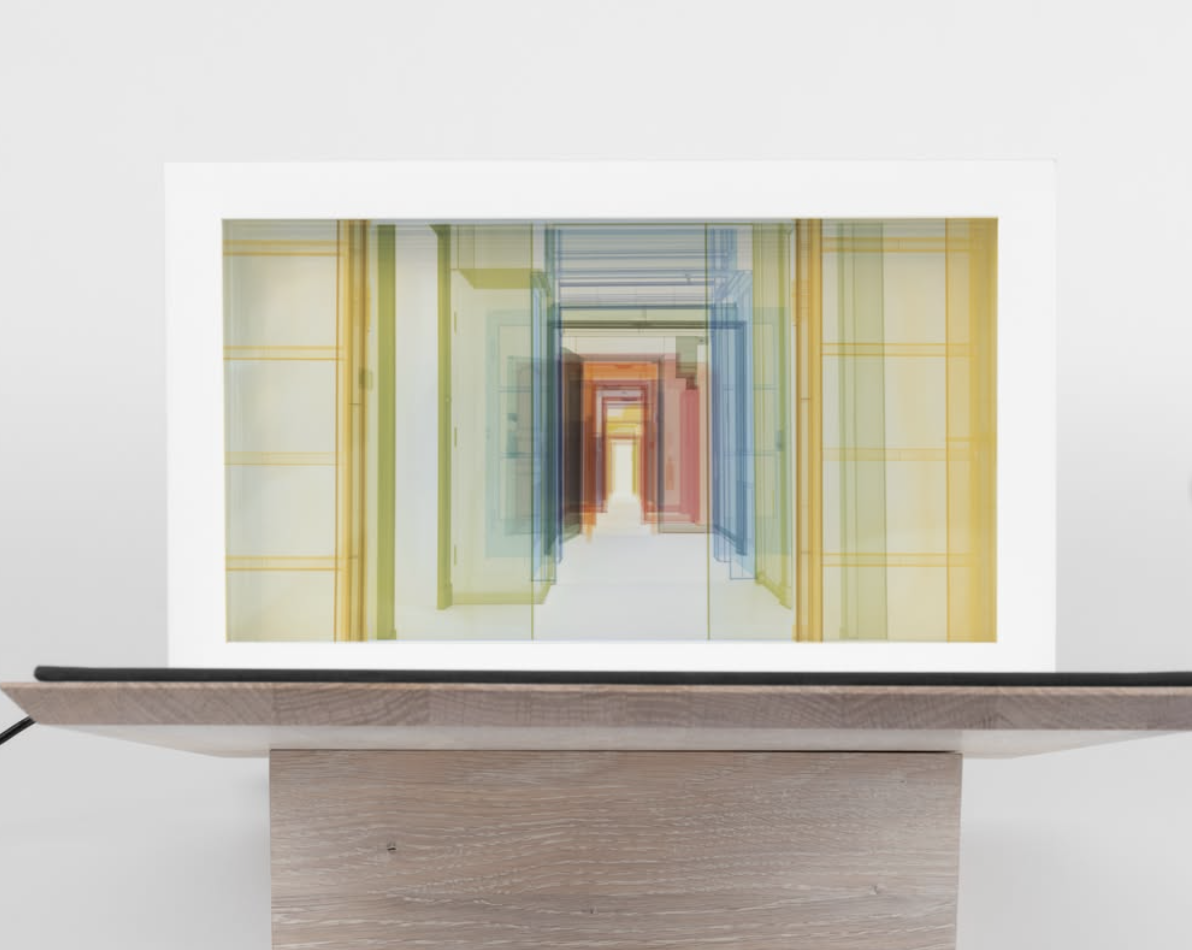
Passage/s, 2022
card, paper and printed acetate film with clothbound case
photography Julien Gremaud
© Do Ho Suh
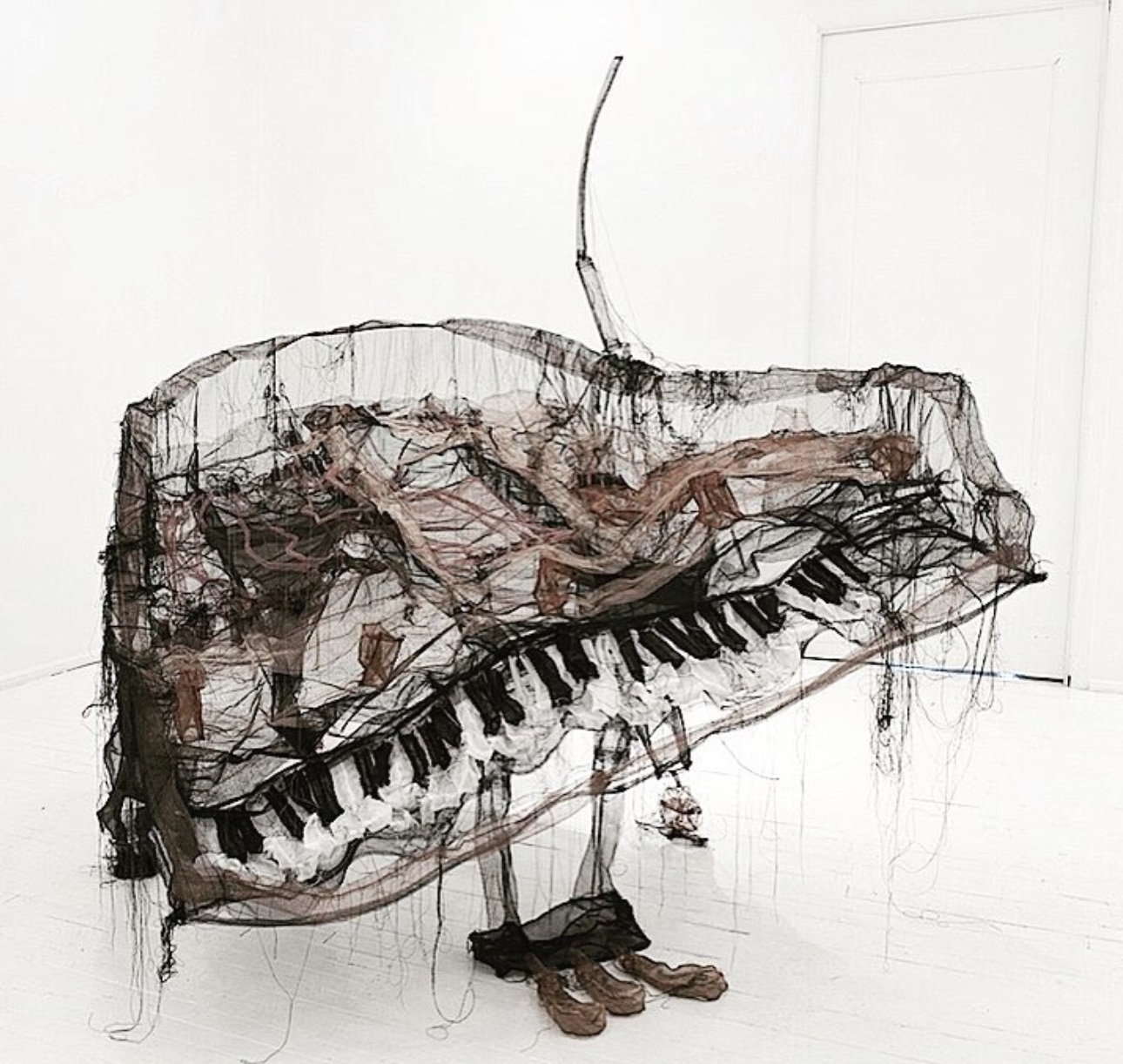
Whats Left
2010
Jannick Deslauriers
Once the wire armature for the manatee skull was complete, another challenge emerged: how could I join the structure without welding?
I tried soldering wire, resin, and several different methods of binding the intersections together. Some were too weak. Others were messy or incredibly time-consuming. Meanwhile, the exhibition deadline was getting closer, and I still hadn’t begun wrapping the sculpture in fabric.
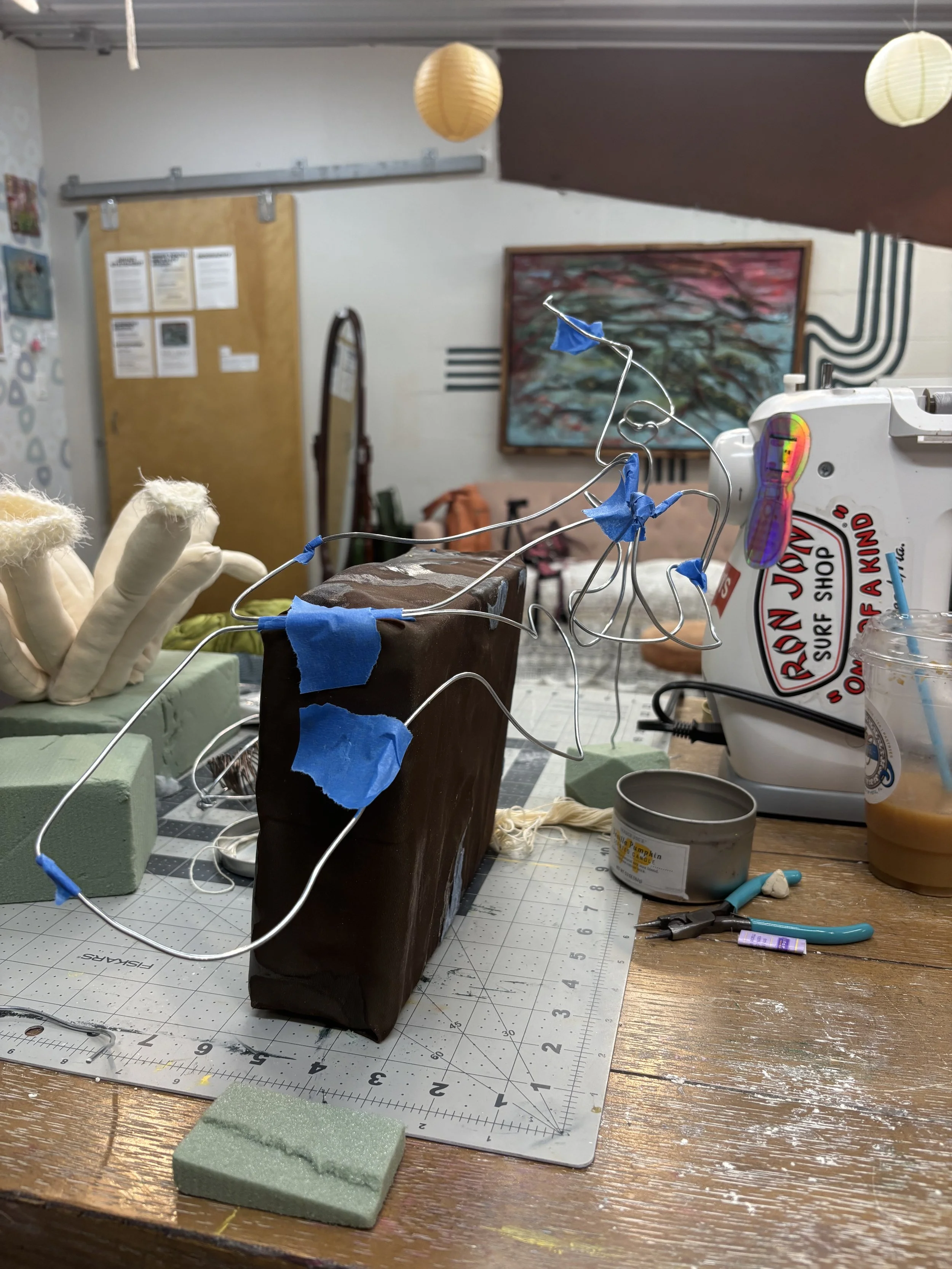
Early days: One half of the wire foundation of Wake Zone (Manatee Skull)
Ironically, the solution turned out to be one of the simplest materials in my studio;
Embroidery thread.
Carefully wrapping every joint with thread not only created cleaner connections but also reinforced the structure while preparing it for the fabric. What had initially been a frustrating obstacle became an important part of the finished piece. Sometimes the solution isn’t adding more complexity—it’s finding the material that’s quietly been waiting for you all along.
After countless hours of wrapping, stitching, and layering recycled sheer textiles over the wire, I considered painting the sculpture. In the end, I decided against it. Keeping everything within a single muted palette allowed the piece to feel calm, unified, and contemplative.
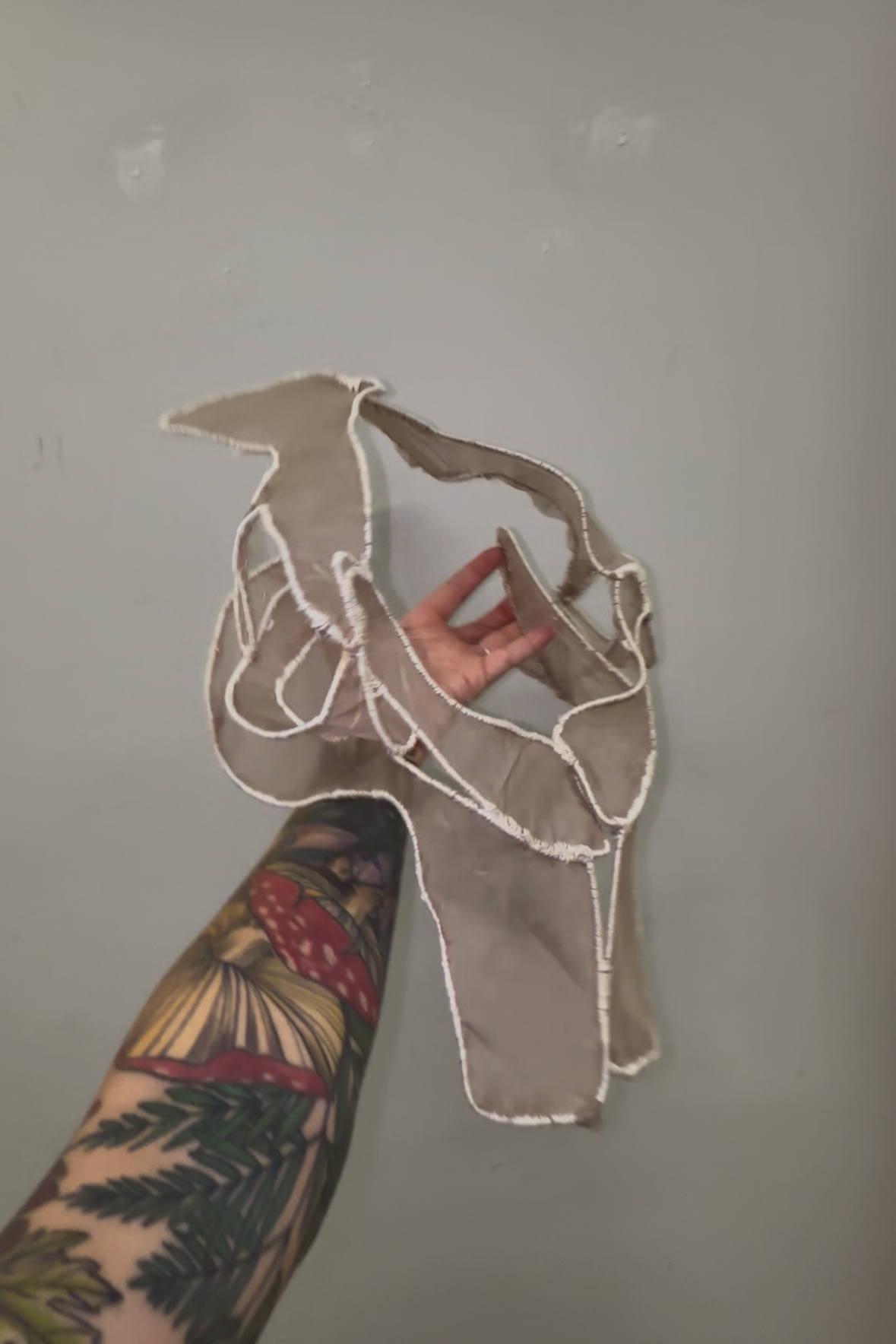
Image still of wire form after applying thread connections.
To complete the installation, I created small anatomical forms from recycled cotton and cashmere yarn. Their soft, organic shapes echoed the colors of the manatee skull and introduced another layer of visual storytelling. Mounted on hand-shaped air-dry clay forms that resemble the ocean floor, they helped ground the sculpture while reinforcing the quiet, underwater atmosphere I wanted the work to evoke.
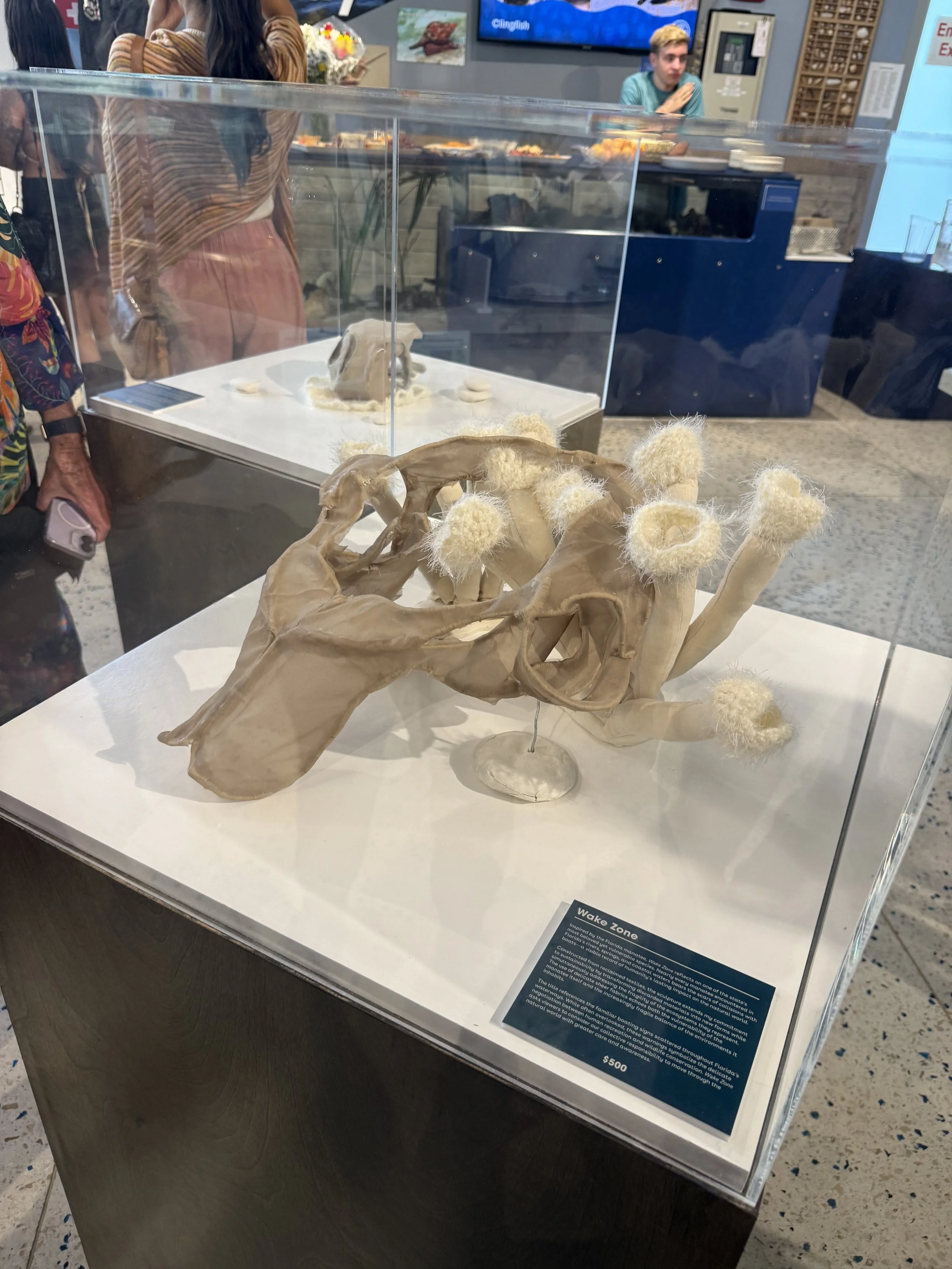
Wake Zone on display at Soul Tides Exhibition, at the Tampa Bay Watch Discovery Center, 2026
Looking back, Wake Zone feels like the beginning of something much larger.
This sculpture brought together conceptual thinking, metal fabrication, textile work, embroidery, and recycled materials in a way that none of my previous pieces had. It became a bridge between different parts of my practice and hinted at where my work might go next.
The process was challenging, frustrating, and filled with uncertainty. It took weeks of experimentation to develop techniques that, now, I could probably repeat in a fraction of the time. But that experimentation was the work. Every failed approach brought me closer to a process I can continue to build upon.
As artists, we rarely know exactly how we’ll arrive at an idea. Sometimes you simply have to trust the vision enough to begin, even when the path isn’t clear.
Wake Zone will be on view as part of my Soul Tides exhibition at the Tampa Bay Watch Discovery Center through October 16. If you’re in the area, I hope you’ll experience it in person. The Discovery Center is open daily from 9:00 a.m. to 5:00 p.m. 💙